API Bay
APIs on your data, without the worries.
Coding, hosting, backups, uptime, discovery and distribution are ours. Pricing and revenue are yours — 0% commission.
Hosted datasets, served as priced APIs. Publish yours and set any price from $0.20 per 1,000 requests. Or call what is already in the bay at $1 per 1,000 requests, free up to 100 a day, no card.
dataset → api → revenue
Every number on this page is the whole number. No bundles, no overages, no percentage of your revenue.
One dataset, both sides of the bay
nyc_water_consumption, from a CSV to a priced call.
Parked by one publisher, listed in Discover, called from the playground. Every number on the three screens is from the console as it runs today.
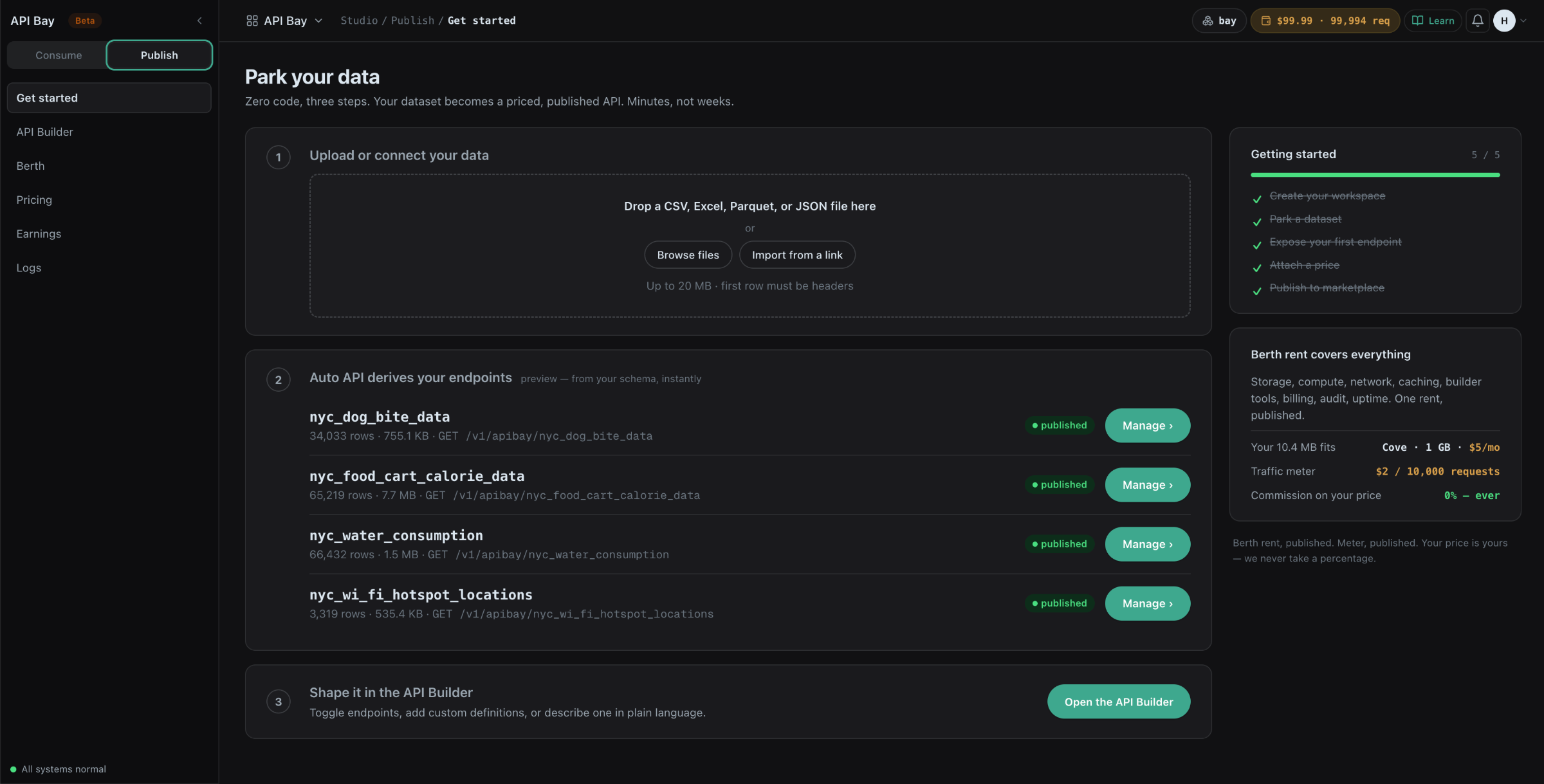
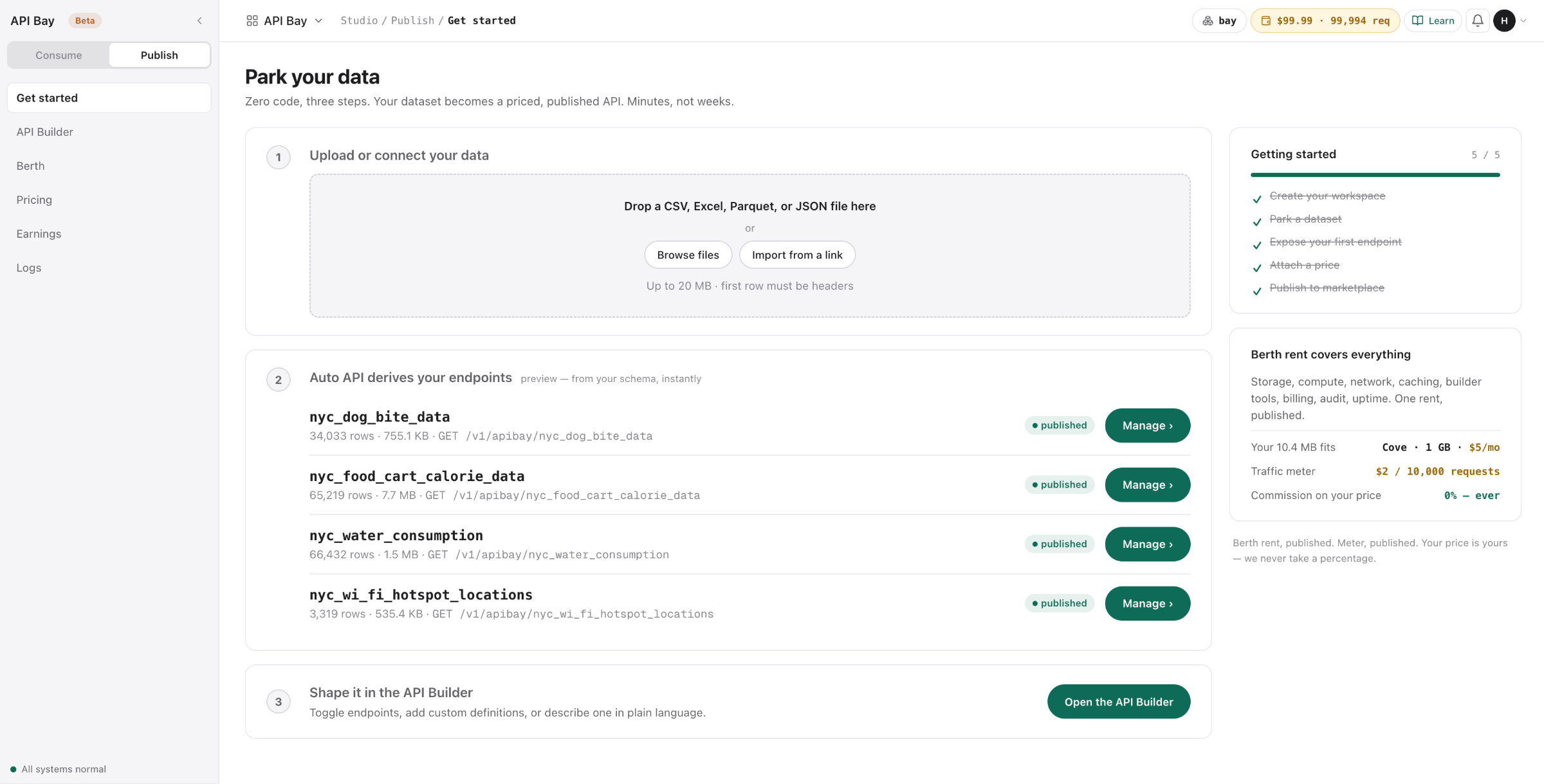
A 1.5 MB CSV of New York City water bills, 66,432 rows, dropped on the Publish tab. Auto API derived GET /v1/apibay/nyc_water_consumption from the column types; three more datasets from the same publisher sit beside it. All 10.4 MB fits a Cove berth at $5 a month.
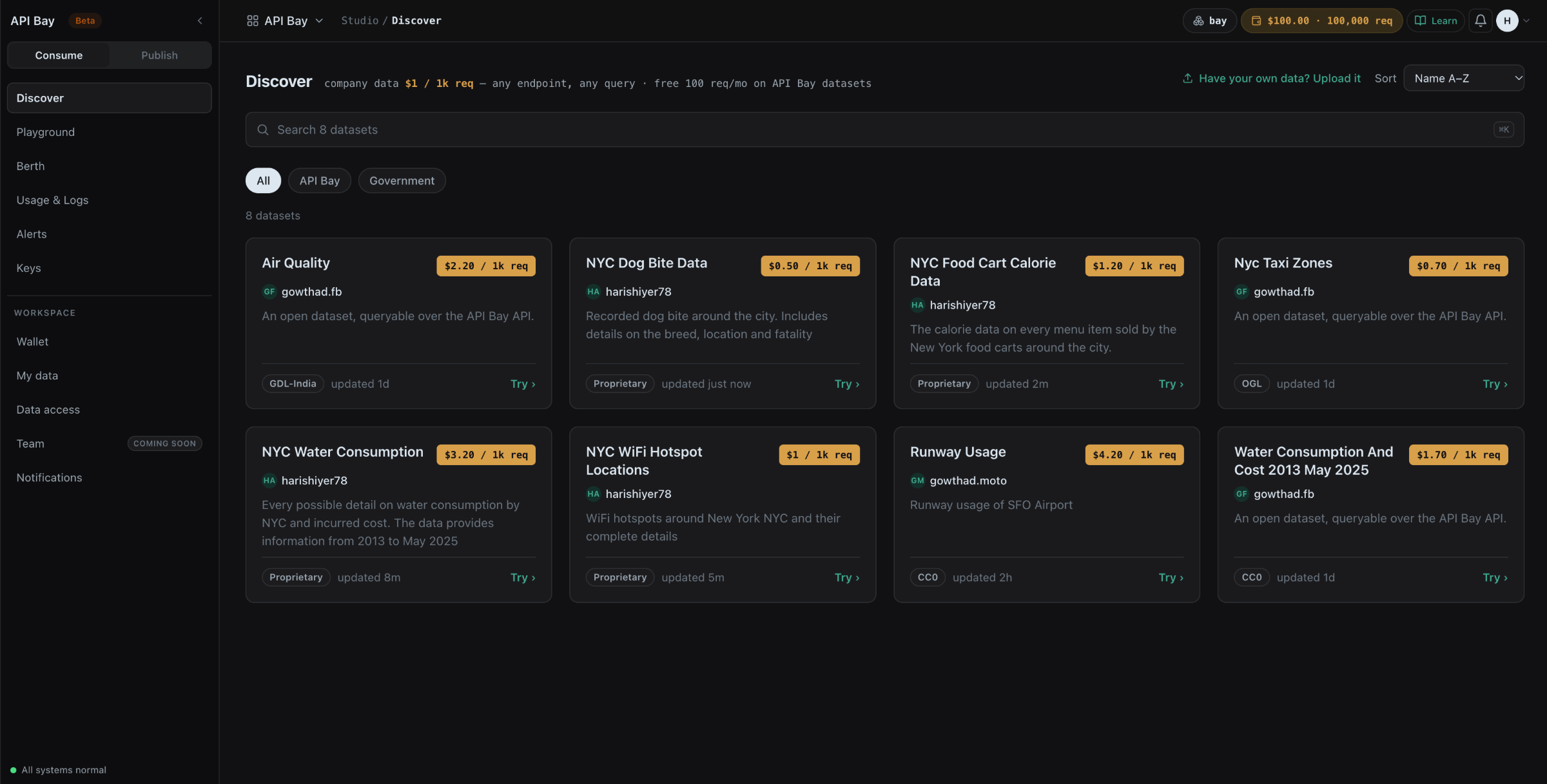
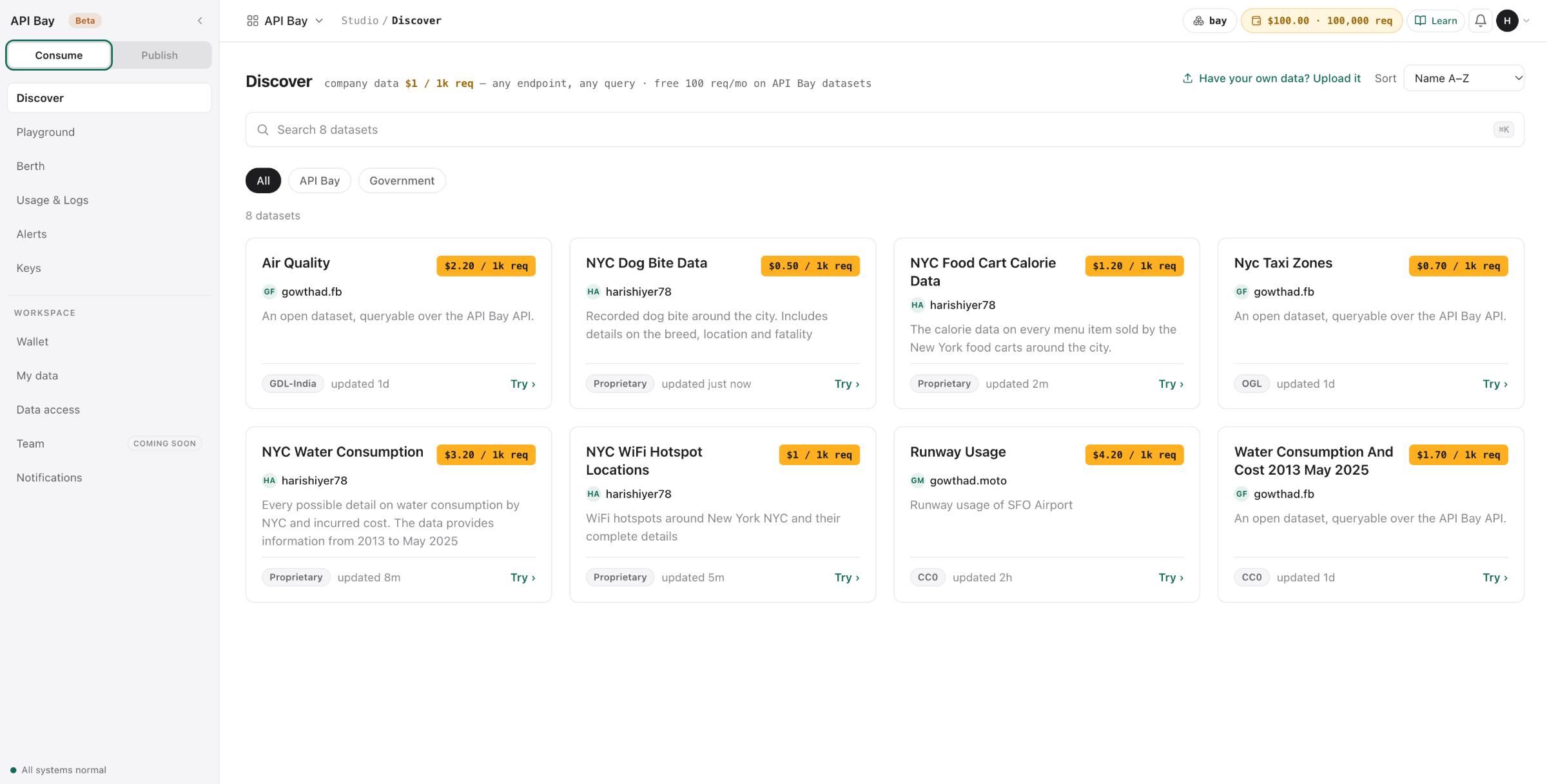
The same dataset in Discover, beside seven others, at the price its publisher set: $3.20 per 1,000 requests. Publisher, licence and freshness sit on the card; Try opens it in the playground.
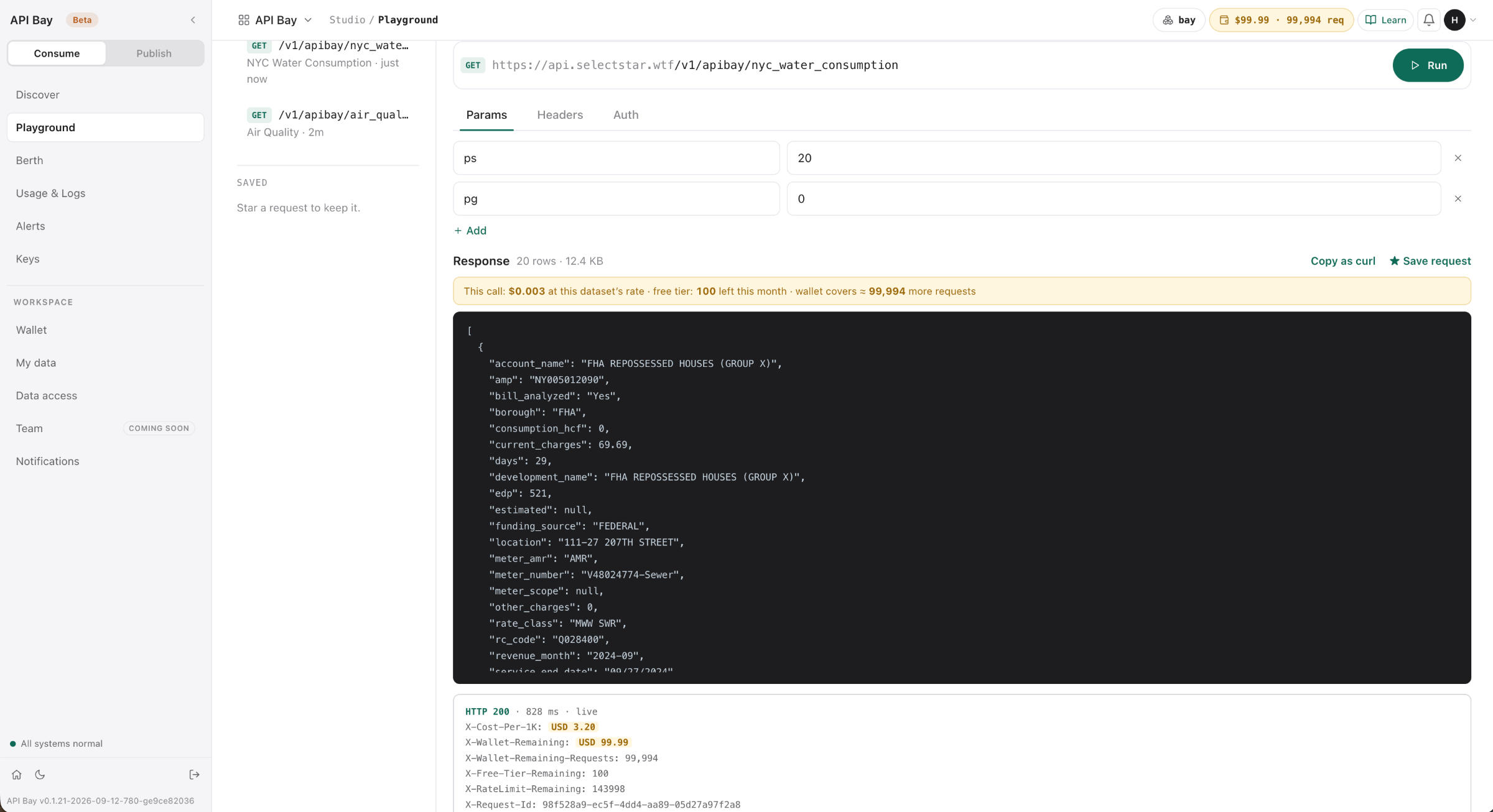
GET https://api.selectstar.wtf/v1/apibay/nyc_water_consumption, twenty rows a page. 12.4 KB back, HTTP 200 in 828 ms. The headers price the call before you read the body: X-Cost-Per-1K: USD 3.20, this call $0.003, wallet covers 99,994 more.
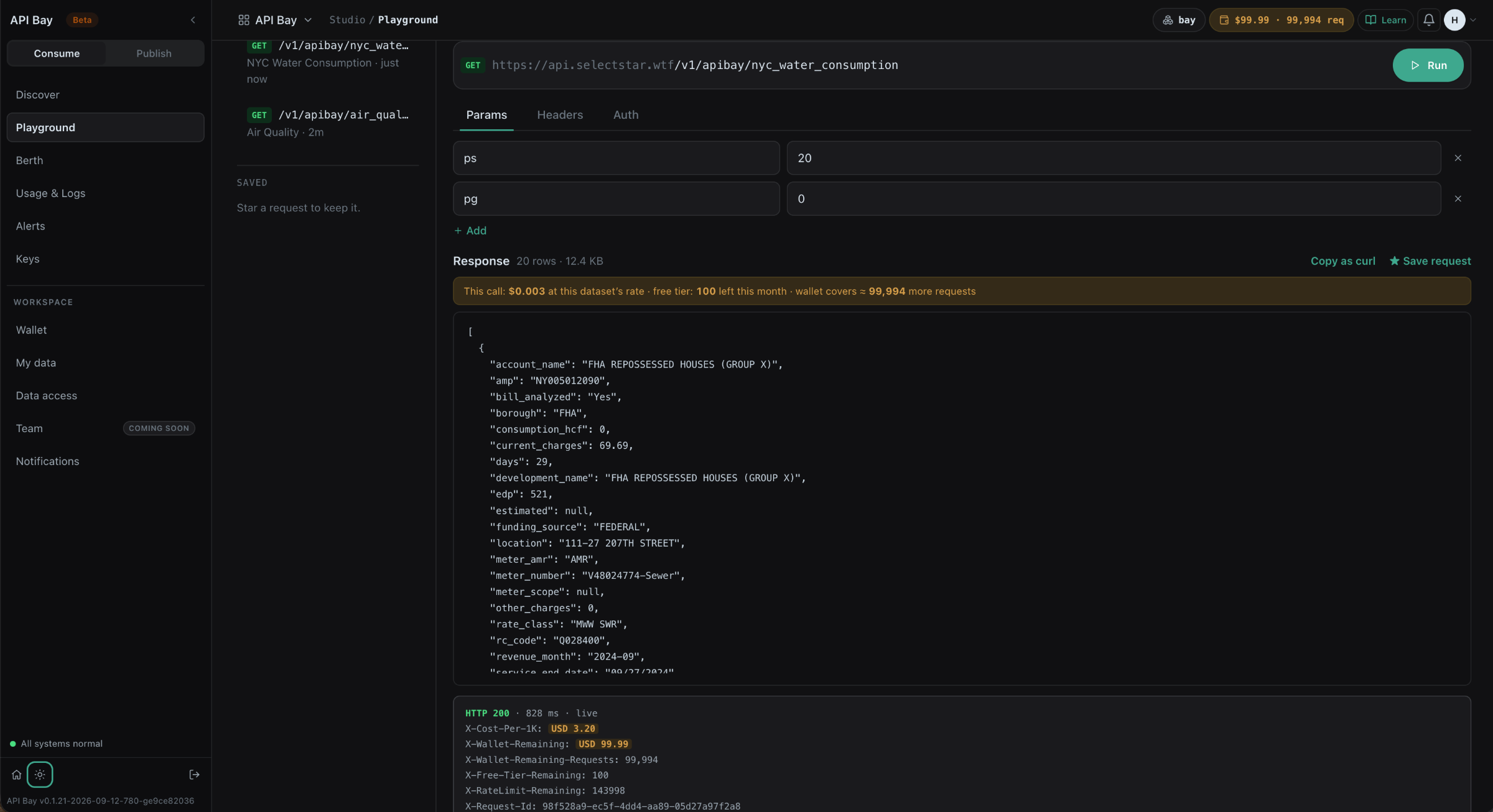
Two sides of the same bay.
One side needs data it does not have. The other has data nobody can reach. API Bay is the dock between them.
| Using dataCall what is already in the bay. | PublishingPark yours and price it yourself. | |
|---|---|---|
| What you bring | A key, and nothing to host. | A flat file in any of five formats, or a database connection. |
| What you pay | $1 per 1,000 requests on the datasets we host, from credits loaded before they are spent. Published datasets carry their publisher’s price. | $5 a month and up to park the data, plus $1 per 5,000 requests served. |
| What you get | Versioned REST endpoints and MCP tools, callable today. | Documented, metered endpoints at a price you set, and the audit of every call they take. |
| What cannot happen | A bill larger than the wallet you loaded. | A commission on your price. We take 0%, at any scale. |
| Browse the bay | Talk about publishing |
Your wallet is the ceiling.
Credits are loaded before they are spent and work across every dataset in the bay from a single key. One rate covers every dataset we host, whatever the query asks of it. Datasets parked by publishers carry the price their publisher set.
No such thing as an overage.
Spend stops at what you loaded. Auto-refill exists, is off by default, and obeys a monthly ceiling you set.
Every response prices itself.
The X-Cost-Per-1K header comes back with the data, so the cost is visible before the next call, not after the month.
Caps per dataset.
Tighter control where you want it: a spending limit on any single dataset, independent of the wallet.
Published data is priced by its publisher.
Datasets parked by independent publishers carry their own listed price, shown on the endpoint before you spend a credit. The free 100 a day does not apply to them — the first request is billed at the publisher’s price. Increases take 30 days notice.
Credits are valid for 12 months. The free 100 requests a day apply to the datasets we host, and never expire.
From a file to a priced endpoint, without code.
Bring a flat file in any of five supported formats, or connect a database. Three ways to shape what it exposes, one lifecycle to publish it: draft, test, attach a price, publish.
Auto API
Endpoints derived from your schema the moment the data lands. Edit the table and the API reflects it, with nothing to redeploy.
Custom API
Joins, filters and aggregations shaped visually, saved as views over your data. The footprint impact is shown before you save.
AI Builder
Describe the endpoint in a sentence. Preview the definition and the sample response, refine it, publish it. Bring your own model key, or use credits at cost.
See every call.
A complete usage audit lives in the studio — every call your API takes, in full detail, with live traffic and earnings per endpoint.
Two lines, and one of them is yours.
Parking is flat rent for keeping data live as a product: replicated storage, compute, network, caching, the whole zero-code toolchain, billing and payout rails, audit logging, monitoring and uptime. Traffic is $1 per 5,000 requests served, from the first request. Your own price is the third line, and we take none of it.
Ten times the data, five times the price — the rule holds at every step. Your footprint counts tables, views, materialized views and indices; you can sit 10% over your tier for a week without anything happening. The full rate card →
A worked month. A researcher parks 5 GB on Inlet, prices at $1 per 100 requests, and serves 50,000 requests.
Our share is the $25 of rent and the $5 meter. Our share of the $500 is zero. At that price, Inlet pays for itself at 2,525 requests a month.
Getting paid. Payouts run monthly once your balance reaches $10, or accumulate until you say so — a flat rail fee is 12.9% of a $10 transfer and 0.3% of a $400 one. The statement is four lines and a subtraction, and the rail’s fee is passed through at cost, itemized, never marked up. Indian tax deducted at source (1% under Section 194-O) is deposited against your PAN.
What you can’t do. Authentication for your own users, third-party integrations, and logic that has nothing to do with your database. That work stays yours to build, manage and maintain.
The short answers.
What counts as a dataset worth publishing?
The pattern that works: a source that is free to get but painful to use, refreshed often enough that a one-time download goes stale, under a licence that permits commercial use. Parsing what is hard, joining what is scattered, and answering in milliseconds what a dump answers in an afternoon — that is what people pay for. If you are unsure whether yours qualifies, that is a good first conversation to have with us.
Do I lose control of my data?
No. Publishing exposes a queryable service, not a copy for download. You decide what is reachable, you set the price, and you can stop at any point.
What do you take from what I charge?
Nothing. You pay parking on capacity and $1 per 5,000 requests served; both are netted off your earnings before payout. The price you set is yours in full, and the floor of $0.20 per 1,000 exists only to cover the meter — set it there and your data is effectively donated.
How is this different from RapidAPI or Postman’s API Network?
They are storefronts for APIs you have already built and are already running. API Bay starts one step earlier: you bring a dataset, and we generate the APIs and run the hosting, backups, uptime, discovery and distribution, at 0% of the price you set. If you already have a running API and only want a storefront, they are the better fit.
What happens if I stop paying?
Thirty days of read-only grace, with notice to the people subscribed to your endpoints. Parking owed is netted from your earnings first. Everything stays on until that window ends.
Can agents call these APIs?
Yes. Everything in the bay is reachable over MCP as well as over HTTP, so an agent can discover and use a dataset the same way it uses your own tables.
Is there a limit on what a response can return?
Responses cap at 512 KB as fair use; paginate beyond that. It is the ceiling that keeps one rate honest for everybody calling.
Bring the dataset. We will do the rest.
Book a session and we will look at what you have, what it would take to publish it, and whether there is an audience worth publishing it to. If the answer is no, we will tell you that.